Blog

  • Redesigning the experience to encourage discovery without losing the magic

    Redesigning the experience to encourage discovery without losing the magic

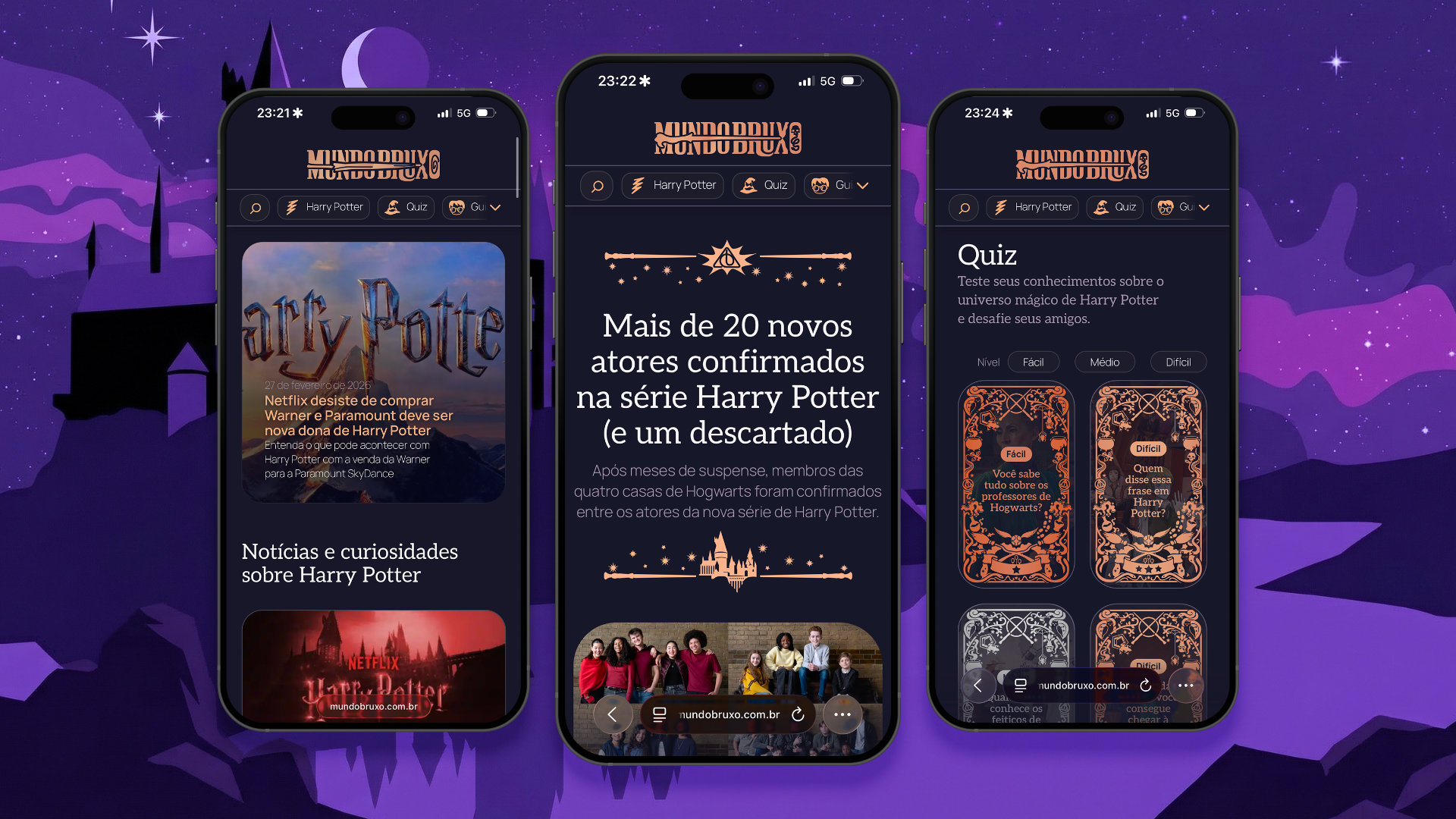
    Mundo Bruxo is a Brazilian portal dedicated to the Harry Potter universe. Over the years, the site accumulated a large library of editorial content and began receiving most of its traffic through search engines and Google News.

    This created a clear behavioral pattern: most readers landed directly on a specific article and rarely explored other areas of the site. In 2025, sessions consistently averaged 1.2 pages per visit throughout the year. At the same time, the average session duration exceeded one minute, suggesting that readers were engaged with the article they came for but rarely moved beyond it.

    Key challenges

    The site was experienced as isolated pages

    Most visitors arrived through Google and rarely navigated beyond the article they came for.

    Too many competing elements for attention

    Intrusive elements, including pop-up and auto-inserted ads, disrupted the reading experience.

    The visual identity no longer reflected the quality of the content

    Intrusive elements, including pop-up and auto-inserted ads, disrupted the reading experience.

    The redesign set out to modernize the visual identity and improve navigation depth, while preserving and strengthening the sense of wonder fans expect.

    Reimagining the brand

    An unexpected issue with the previous identity was legibility. The way the wand split the name often made users read the title as Mundodruxo.

    Previous logo
    Before
    New logo
    After

    The redesign reorganized the typographic composition and simplified the serifs to improve legibility, especially on mobile, while preserving the magical character of the type.

    The central wand was filled and now points to the right, casting a spell into the letter O, marked by Harry Potter’s iconic lightning bolt. The logo also adopts a golden tone, reinforcing its connection to the Harry Potter universe.

    The logo appears in multiple variations across pages and loading states, referencing different characters through their wands and signature spells:

    Content as the center of the experience

    The redesign of the editorial page started with a simple premise: less distraction, better reading.

    The layout was simplified by removing sidebars and reducing intrusive elements, including auto-inserted ads that often interrupted the reading experience. Typography, contrast, and spacing were refined to improve readability during longer reading sessions.

    Elements appearing at the right moment

    Floating buttons for sharing, commenting, and liking, inspired by modern social networks, appear once readers are already immersed in the article, encouraging engagement without interrupting reading.

    Designing for deeper exploration

    The navigation was redesigned to encourage exploration across sections, making the site’s structure more visible while keeping fixed elements minimal and non-intrusive.

    A fixed header introduces the main sections through horizontal navigation alongside search. The logo collapses during reading and reappears on scroll up, and the menu can expand into a full list view, keeping key categories like “Harry Potter” always visible.

    Respecting the reading experience

    Monetization was preserved but made less intrusive, with clearer ad labeling and fewer disruptive formats to maintain a more respectful reading flow.

    Magic lives in the details

    Beyond structural improvements, the redesign also aimed to reinforce the magical tone of the experience.

    [Vídeo curto do logo animado]

    Subtle microinteractions were introduced throughout the interface, such as the animated shine that appears on the logo during page load.

    These details are intentionally understated, but they help establish the atmosphere of the site.


    [Vídeo dos cards de quiz reagindo ao movimento]

    Quizzes received a more expressive visual treatment, with illustrated frames and interactive animations.

    The main card subtly reacts to cursor or touch movement, creating a sense of depth and responsiveness.

    The frames also communicate difficulty levels using medal-inspired colors: bronze, silver, and gold.


    Illustrations inspired by the books

    [Carrossel com ilustrações do rodapé]

    Each page ends with an original illustration depicting a memorable moment from the saga.

    These scenes were created based on descriptions from the books, rather than the film adaptations, resulting in visual interpretations that sometimes differ from the cinematic imagery.

    This choice reinforces the site’s own identity within the Harry Potter universe.


    Early results

    The new design was launched recently, but the first indicators already point to improvements in the overall experience.

    • average navigation depth increased by [INSERIR DADO REAL]
    • average time on site grew by [INSERIR DADO REAL]
    • interactions such as likes, comments, and shares increased by [INSERIR DADO REAL]

    Beyond quantitative metrics, qualitative feedback from readers highlights:

    • the new visual identity
    • reduced distractions during reading
    • clearer navigation between related content


    Learnings

    Editorial platforms require a delicate balance between content, monetization, and reading experience.

    In this project, relatively small structural decisions — such as keeping navigation visible during reading — had a larger impact than visual changes alone.

    At the same time, identity design and microinteractions helped reinforce the emotional dimension that fans expect from a site dedicated to the Harry Potter universe.

  • Creating the design system that enabled a professional and scalable SMS platform from day one

    The SendQ platform is a corporate SMS and marketing automation product created in Florida, USA. Like many early-stage digital products, it was born as a functional skeleton built by developers: it worked, but it lacked identity, visual cohesion, and any real sense of user logic. To earn trust and compete in the market, that raw prototype needed to evolve into a professional, intuitive, and scalable product.

    Turning technical complexity into a clear and modern user experience

    My role was to translate the developers’ technical vision into a user-centered, comprehensible interface. The product arrived with its initial features already defined; my responsibility was to shape it, give it coherence, and design how everything would come to life.

    Before structuring the visual identity and platform logic, I conducted a competitive review focused on leading CRM, marketing automation, and email campaign tools. I analyzed patterns in architecture, usability, and functionality to surface best practices and anticipate future evolution paths for the product.

    With that foundation, I was able to define the core that allowed SendQ not only to launch as a product, but to debut as a mature, competitive, and scalable platform from day one.

    Solução

    A solução central foi construir um Design System sólido e escalável. Em vez de criar telas isoladas, desenvolvi uma linguagem visual e uma biblioteca de componentes que serviram como base para toda a plataforma. Isso permitiu que o SendQ fosse lançado com consistência e, ao mesmo tempo, com regras claras para crescer sem gerar ruído ou dívida técnica.

    [Espaço para Imagem: Overview do Design System / Tokens]

    Destaques da interface

    Com o Design System estabelecido, os fluxos foram desenhados com foco em reduzir a carga cognitiva e acelerar as tarefas essenciais do usuário.

    1. Navegabilidade e ação principal
      A hierarquia das páginas foi padronizada posicionando a ação principal no canto superior direito. Esse padrão simples criou previsibilidade: o usuário sempre sabe onde olhar para avançar, eliminando a sensação de incerteza do ‘onde eu clico?’.
      [Espaço para Imagem: header com ação principal em destaque]
    2. Editor com feedback em tempo real
      Para lidar com a complexidade de criar formulários, implementei uma visualização em split-screen. O usuário edita à esquerda e vê o resultado final à direita, sem precisar salvar ou recarregar. O fluxo ficou mais leve, rápido e intuitivo.
      [Espaço para Imagem: tela split com editor e preview]
    3. Gestão multicontas
      Pensando em agências, o seletor de contas foi desenhado para ser informativo. Ele exibe saldo e status antes da troca de ambiente, permitindo gerenciar múltiplos clientes sem fricções, re-login ou navegação excessiva.
      [Espaço para Imagem: seletor de contas com saldo]
    4. Dashboard acionável
      Fugi da estética da ‘tabela crua’. O dashboard inicial reúne performance de campanhas e base de usuários com gráficos interativos que revelam detalhes ao passar o mouse. A prioridade foi entregar clareza e insights imediatos, evitando poluição visual.
      [Espaço para Imagem: dashboard com gráficos interativos]
    5. Composer de mensagens
      O fluxo de envio foi projetado para ser linear e seguro. Segmentação, mailing e preview convivem na mesma tela, permitindo edições inline rápidas, objetivas e sem risco de erro.
      [Espaço para Imagem: tela de composer com preview]

    Resultado

    O projeto deu ao SendQ a fundação necessária para entrar no mercado como um produto SaaS robusto. Ele deixou de ser um sistema experimental e se tornou uma plataforma profissional, com uma interface que sustenta com solidez a chegada de novas funcionalidades.

  • Enhancing the Digital Experience to Support Growth, Retention and Everyday User Tasks Across a Scalable Platform

    Enhancing the Digital Experience to Support Growth, Retention and Everyday User Tasks Across a Scalable Platform

    As the platform expanded, users faced increasing friction when navigating key tasks. Many flows still reflected early stage decisions, and new features were layered on top of old layouts without a unified strategy. This created inconsistencies that affected onboarding, task completion and general user confidence.

    To address these challenges, a broad effort was launched to reorganize critical journeys, simplify decision points and ensure the interface supported clarity rather than adding cognitive load. The goal was to set a new foundation for future feature development while improving immediate usability.

    ‘The product needed to grow without becoming heavier. Our focus was making complexity feel simple, not invisible.’

    After mapping the full experience, the team focused on the areas with the highest impact on daily usage. This allowed us to prioritize quick wins while working on deeper structural improvements in parallel.

    Revealing the reasons behind user friction by analyzing behaviors, patterns and decision points.

    Research Flow Summary

    Research showed that while users understood the platform conceptually, the interface did not reflect their mental models. Navigation was inconsistent in naming and placement, and several core tasks required unnecessary back and forth. These findings shaped the redesign strategy.

    To maintain alignment with business needs, we also mapped cross team dependencies and technical constraints. This prevented rework and made the project a shared initiative rather than an isolated UX improvement.

    The solution required balancing structural adjustments with pragmatic improvements to ensure the new experience felt coherent without disrupting ongoing development.

    After consolidating insights and patterns, the team created a modular structure that allowed features to scale while remaining intuitive. Components were reorganized, labels were simplified and task flows were reduced to fewer steps.

    Visual hierarchy was strengthened to guide attention and reduce confusion. Prototypes were tested iteratively, and refinements improved success rates and reduced hesitation during key actions.

    1. Eles deveriam ter tamanhos distintos
    2. Eles deveriam parecer subníveis uns dos outros
    3. Talvez o espaçamento entre linhas também ajude na separação
    4. Mais um elemento para verificar isso
    5. O quinto dos elementos

    Já este é um título de terceiro nível (só não parece)

    Você consegue perceber diferença entre eles? Contudo, há ainda pontos que nos explicam onde pode ter dado errado:

    Olha, outro link aqui! A diferença é que dessa vez estamos tratando de algo que contém um link enorme que com certeza ultrapassará a linha e pegará diversas linhas.

    Research Flow Summary

    Uma frase de impacto para abordar melhor

    Final refinements focused on interaction polish, clearer feedback states and documentation to help teams maintain consistency over time.

    Through research, design and collaboration, Project Atlas delivered an experience that is more predictable, simpler to navigate and better aligned with user needs. It also established a flexible foundation for future product growth.

  • Hello world!

    Welcome to WordPress. This is your first post. Edit or delete it, then start writing!